


Landing a commuter bike that’s not too heavy to carry up and down steps or on a train can change your daily routine. Weight is more than a nicety; it's freedom in the city. This guide will take you through the key features that make a bike more portable, from what materials it is made of to how it packs down, and show you some models available that offer an easy-to-carry commute.
ENGWE E26: The Contemporary Commuter's Choice
"ENGWE具体型号文字"ENGWE E26"所在段落的段落标题(即带<h>标签的文字)的正下方,即处于该段落的段落标题和段落内容中间."
No matter how comfy, practical, or well-designed a commuter’s mode of transport may be, it all starts with a fantastic electric bike. The ENGWE E26 is a great option for the contemporary commuter who won't settle. In the traditional sense, power equals weight, but ENGWE has totally challenged “the rule” by rethinking what a power bicycle should be and how that power should be delivered. The E26 is an e-bike designed to conquer the rigors of real-world commuting. Its considerate ergonomics and step-through frame style change the game in terms of ease of use, while the revolutionary design fits all riders for easier to get on and off at checkpoint lights. The bike adds a new level of versatility, making this an excellent choice for every activity from commuting to long weekend trail rides. The powerful motor isn’t just about giving you a helpful boost to your pedal power, though; it effectively makes the whole commuting process far less exerting and drains you significantly less on arrival.

Step-Through Frame
This is one of the most important features to give women ease while getting on or off. Not having to climb your leg over a high bar is a real plus if you're carrying bags or are in formal clothes. It additionally offers a better "on-bike" balance and center of gravity, which translates to better handling when wheeling the bike around in your hand.
Strong Assist
The strong motor makes the hill feel flat and the headwind become a tailwind. And that means you don’t have to do as much of the work either physically while riding or mentally — which is nice because now you have one less thing stopping you from taking on more difficult parts of your route.
All-Terrain Capability
The ENGWE E26 is not limited by perfect pavement. It’s made to last, and paired with its capable tires, you can ride it comfortably on a variety of urban terrains, whether bike lanes, park paths, or cobbled streets. And that flexibility lets it act as one of your only commuting and casual bikes.
Frame Materials: The Foundation of Portability
The most important factor in a bike’s weight, according to Ghadiali, is its frame material. Knowing what makes them different is important in determining the right lightweight one for you within a suitable price and durability range. Each has a different combination of properties, and the lightest is not always best for every rider. An informed decision here is the first step to having a bike that will actually be easy to carry.
Carbon Fiber
The Uncompromising Lightweight Champion: Absolutely the reigning champion in low weight. It’s insanely strong, incredibly stiff and also does an epic job of soaking up road vibrations so your bike ride is a comfortable one. But it’s the priciest substance and subject to sharp blows.
Aluminum Alloy
The most popular material for a light bike frame, offering an excellent combination of weight and strength at an affordable price. Today’s aluminum frames can get awfully close in weight to low-end carbon, though you may feel a rougher ride as a result.
Titanium
An upscale, "forever" material. It’s nearly as light as aluminum but provides the pleasant, compliant ride of steel and will never corrode. The primary reason this product is not favored is due to its high price.
Chromoly Steel
A strong and lightweight type of steel, recovering from deflections, producing a smooth yet responsive feel. It’s heavier than aluminum or carbon, but the ride is incredibly smooth and forgiving, so a lot of long-distance commuters love it.
| Material | Typical Weight | Price | Durability & Ride Feel |
|---|---|---|---|
| Carbon Fiber | Lightest | Priciest | Insanely strong, stiff, soaks vibrations; subject to sharp blows. |
| Aluminum Alloy | Light | Affordable | Good strength; can feel rougher than carbon/steel. |
| Titanium | Nearly as light as aluminum | High | Compliant, “magic carpet ride”, for life; never corrodes. |
| Chromoly Steel | Moderate-heavy | Mid-range | Strong, smooth, forgiving, responsive; classic feel. |
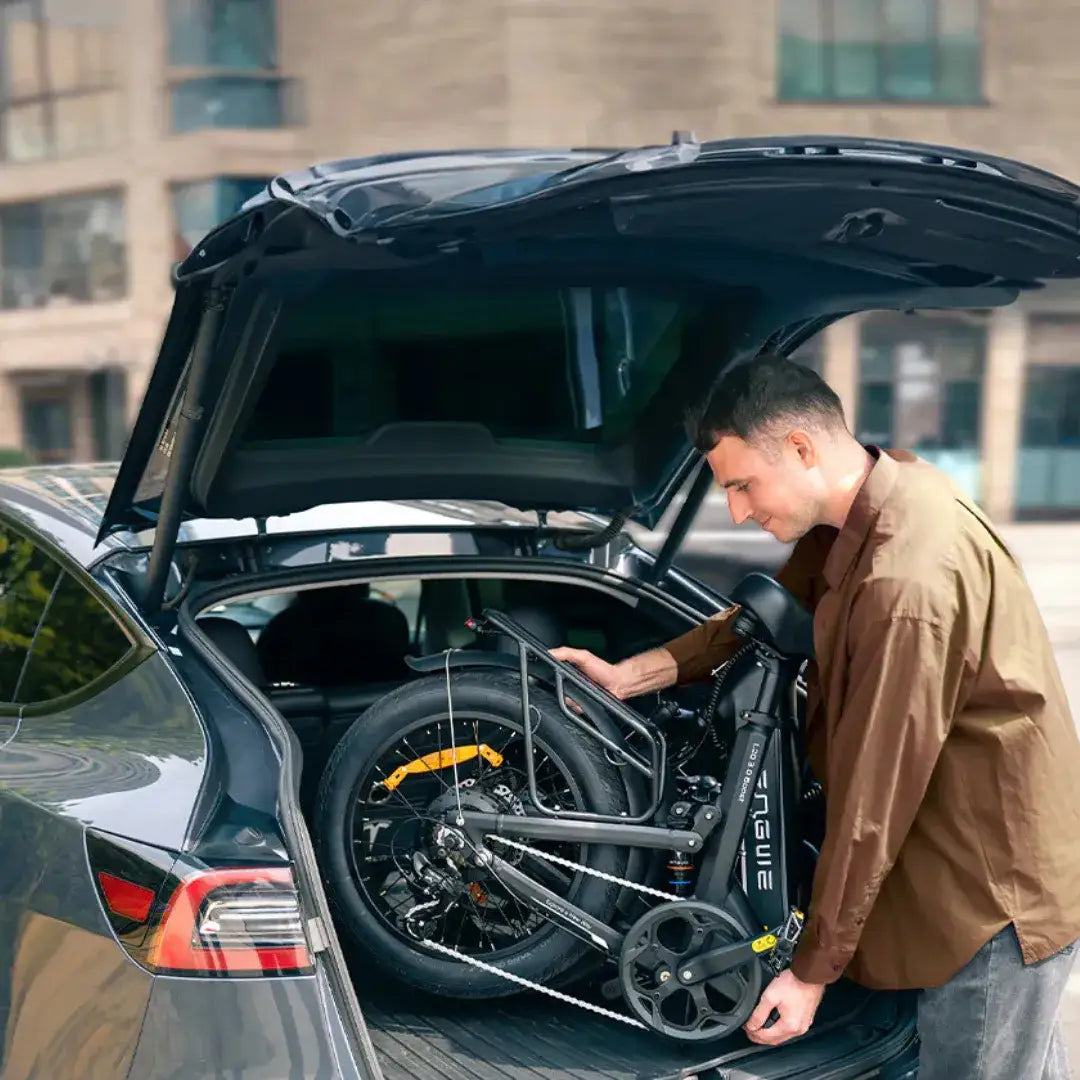
Folding Bikes: The Ultimate in Portability
Folding bikes are the easiest to carry, hands down. These models are designed to be multi-modal commuters that you can ride, fold, and carry aboard public transportation or into your office. The important aspect is to not only consider the weight, but also how it folds up and what size it becomes once folded — as these also play an equal part in being portable.
Folding
Check that the folding mechanism is easy to use and securely locks. You should be able to fold or unfold the bike in less than 30 seconds, which is best. Test in the store before you buy. Even folded, a complex fold on an ultralight bike is a daily irritation.
Folded Size
A light weight is no good if the folded bike is a big, unwieldy mess. The most travel-friendly folders shrink into suitcase-like packages that are simple to stash under a desk or on a luggage rack. Make sure any protruding parts, such as pedals or handlebars, fold away neatly as well.
Wheel Size
Fold-up bikes generally have smaller wheels (16” or 20”) to accomplish a tighter fold. For urban riding on good pavement, they’re great, but at higher speeds they can feel less stable than full-size wheels and are more susceptible to potholes. A few models have 24-inch wheels to balance ride comfort with carrying compactness when folded.
Carry-ability Features
The best are designed to be rolled on their own wheels when partially folded, which can make a big difference in terms of how much you need to lift them. Others have built-in handles or provisions for shoulder straps and carry bags.
Conventional Pedaled Bikes
As great as having a power-assisted option is, the conventional pedaled world provides some of the lightest machines around. These bicycles shed pounds through minimalism, advanced materials, and a concentration on the pure efficiency of human power. So, if you ride somewhere flat and your No. 1 consideration is the lightest lifting weight, these options are excellent.
Brompton C Line
This British classic is widely viewed as the gold standard of folding bikes, famous for its gorgeous design and ingeniously compact fold, which transforms into a tidy little locked-up bundle. Engineered for everyday carry and multi-modal travel.
Tern Verge Series
Tern's priority is to make the best possible riding experience on a folding bike. With bigger 20- or 22-inch wheels and rigid aluminum frames, they are fast, lightweight, and feel extremely stable on the road.
Single-Speed/Fixed-Gear Bicycles
They are simple and lightweight as they do not have a derailleur, shifter, cable, and cassette. Brands like State Bicycle Co. or Wabi Cycles have models with much better quality, lightweight steel (or aluminum) frames that are perfect for minimalistic commuters.
Specialized Sirrus X 2.0
A best-selling hybrid, this bike features a lightweight aluminum frame and a straightforward 1x drivetrain. It's a great middle ground of light weight, comfortable geometry, and the kind of versatility that makes it capable both on pavement and pebbly trails.

Optimizing for Portability: Shaving Weight and Enhancing Carry
Even outside of the frame, you can also shave quite a bit of weight and enhance portability by picking components strategically and using clever techniques. It all adds up, and the little bit you save in one area may make a significant difference later on when you're dragging your bike out of a ditch every day. This is also a place where you can upgrade later to make your bike perform better and easier to use.
Wheels and Tires
The wheels are one of the best places to save weight. With lighter wheels and tires, it’s easier to carry the bike; they also improve acceleration and climbing. Pro Tip: Replace heavy, flat-resistant stock tires with lighter, more supple ones and shave off a pound or more while improving ride feel.
Simplify the Drivetrain
If you mostly ride flat terrain, you might convert to a 1x (one chainring) or even a single-speed drivetrain. This does away with the front derailleur, shifter, and additional chainrings; it saves a lot of weight and makes for less to maintain.
Upgrade Contact Points
Carbon fiber or lightweight aluminum handlebars, seatposts, and saddles can save grams. Individually, these elements save a relatively small amount, but it adds up.
Get Good at the Carry
For folding bikes, you can use the special handle or carry it like a suitcase. For traditional frames, you’d either crouch low and grab the top tube and downtube, lifting it with your legs so that the top tube can sit on your shoulder. A sturdy bike that holds the weight towards the middle is actually much easier to hold in your arms than an unbalanced one.
What is the most important thing for an “easy to carry” bike?
It's a tradeoff of lightweight and handling. Anyway, a 25lb bike that's unwieldy and unbalanced is more difficult to transport than a 30lb bike that's manageable and has a decent hand-hold. For foldies, the ultimate folded size is as important, if not more so, than the weight.
Can I lighten my bike?
Yes. Begin by taking off anything unnecessary, like a heavy rack or bulky lock (carry locks in a bag instead). The wheelset and tires are the most effective for weight loss, followed by the crankset/cranks and contact points such as seatpost and bars.
Are lighter bikes less durable?
Not necessarily. Material science has advanced significantly. A well-built carbon composite or alloy frame can be extremely strong and performance-built. Ultralightweight racing components often may not be as durable as commuter parts, for example, so select them by weight AND strength.
The ideal commuter bike is one that becomes a part of your life, improving your most common transport experience.