There's no single age requirement for riding an electric bike in the U.S. A 14-year-old may legally ride a Class 1 e-bike in California, for example, but that same rider would be too young to operate an e-bike in New York. It all comes down to state law, bike classification, and where you plan to ride.
Things get a little more complicated with high-speed e-bikes and electric dirt bikes, which don't always fall under the usual bicycle rules.
So, before buying your first e-bike or getting one for a teenager, here's how the ebike age limit works across the country.
What Is the Minimum Age to Ride an Electric Bike?
There is no nationwide minimum age for riding an electric bike in the United States. States make their own rules, and those rules often depend on the type of e-bike.
In many states, younger riders can legally use Class 1 and Class 2 e-bikes, while Class 3 bikes are restricted to riders who are at least 16. Other states take a different approach and set an age requirement for all electric bicycles.
The difference usually comes down to the bike's motor-assisted speed and how state law classifies it.
Here's a quick breakdown:
| E-Bike Type | Motor Assistance | Common Age Rules |
|---|---|---|
| Class 1 | Pedal assist up to 20 mph | No statewide minimum in many states |
| Class 2 | Throttle assistance up to 20 mph | No statewide minimum in many states |
| Class 3 | Generally pedal assist up to 28 mph | Often 16 or older |
| High-speed electric bikes and dirt bikes | May exceed standard class limits | Depends on vehicle classification and local laws |
These are general guidelines, not rules that apply everywhere. Some states use different definitions, and a city or trail manager may have additional restrictions.
The PeopleForBikes state law directory is a useful place to start, but always confirm the current requirements with your state or local authorities.
Ebike Age Limit by Class: Class 1, 2, and 3
Two electric bikes can look almost identical and still fall under different legal rules. That's because most states classify e-bikes by how their motors work and how fast they provide assistance.
Understanding those differences is the easiest way to make sense of the ebike age limit.
Class 1 and Class 2: Up to 20 MPH
Class 1 and Class 2 e-bikes share the same motor-assistance speed limit of 20 mph under the common three-class system. The difference is how you get that assistance.
On a Class 1 bike, the motor kicks in when you pedal. You still do the pedaling, but the added power helps when you're starting from a stop, climbing a hill, or riding into a headwind.
Class 2 bikes also allow throttle operation. That means the motor can propel the bike without the rider having to pedal.
Many states don't set a minimum riding age for either class. Still, legal permission doesn't necessarily mean a child is ready to handle the bike.
A heavier bicycle with motor assistance can take practice to control, particularly when starting, turning, or stopping. That's one reason the American Academy of Pediatrics recommends starting appropriately prepared riders ages 12–15 with Class 1 e-bikes, where local laws allow them.
Class 3: Up to 28 MPH
Class 3 e-bikes generally provide pedal assistance up to 28 mph, making them faster under motor power than standard Class 1 and Class 2 bikes.
Many states require Class 3 riders to be at least 16 years old.
At higher speeds, riders have less time to react to an unexpected car door, a pedestrian stepping into a bike lane, or a sudden change in traffic. Braking distance also increases with speed.
There's an important detail here: 28 mph usually refers to the speed at which motor assistance stops. It doesn't mean the bicycle is physically incapable of going faster downhill or through pedaling.
And not every state follows the same classification system. New York, for example, has its own Class 3 definition with a 25 mph motor-assistance limit.
If you're buying a faster electric bicycle, don't rely on the advertised top speed alone. Check how your state defines that particular class.
High-Speed E-Bikes and Electric Dirt Bikes
Some electric bikes offer much higher speeds and motor output than the standard three-class system allows.
That's where the legal distinction becomes especially important.
A powerful electric bike might resemble a conventional bicycle, but depending on its specifications, it could fall under rules for mopeds, motorcycles, or off-road vehicles.
Electric dirt bikes present a similar situation. A machine capable of 40 or 45 mph isn't automatically considered a Class 3 e-bike, even if it's marketed alongside electric bicycles.
The same goes for speed settings. Switching a high-performance bike into a slower mode doesn't automatically change its legal classification.
For riders interested in these machines, the question isn't simply how old you need to be. You also need to know what kind of vehicle you're operating and where you're allowed to use it.
Ebike Age Limit by State: Why Location Matters
A teenager who can legally ride an e-bike in one state may not be allowed to ride the same bicycle across the state line.
California and New York are good examples of how different the rules can be. And as new legislation comes into effect, it's worth checking the dates rather than relying on an older online guide.
California: Different Rules for Class 3
California doesn't set a statewide minimum riding age for qualifying Class 1 and Class 2 electric bicycles.
Class 3 is different. Riders must be at least 16 years old, and anyone operating a Class 3 e-bike must wear a helmet.
California also requires bicycle helmets for riders under 18.
Here's what that means in practice. A 14-year-old may be legally old enough to ride a qualifying Class 1 electric bike, but that same teenager cannot legally operate a Class 3 e-bike.
The bike's specifications matter, too. California's electric bicycle definition includes limits on motor power and assisted speed. A vehicle outside those limits may be regulated differently.
Before heading out, check the California Highway Patrol's guidance on motorcycles and similar vehicles.
New York: A Minimum Age of 16
New York takes a more straightforward approach to age.
You must be at least 16 to operate an electric bicycle in New York State, regardless of whether it's Class 1, Class 2, or Class 3.
The state's classification system also differs from the standard three-class model. Class 3 e-bikes are permitted only in New York City and have a motor-assistance limit of 25 mph.
Where you ride matters as well. New York generally allows qualifying e-bikes on roads with posted speed limits of 30 mph or less, although additional local restrictions may apply.
That means a 16-year-old meeting the state's age requirement still needs to make sure the bike itself is permitted on the intended route.
For full details, see the New York State Department of Transportation.
Local Restrictions and Changing State Laws
Electric bike laws aren't set in stone.
Illinois, for example, is changing its minimum-age rules. As of November 2026, the state requires Class 3 riders to be at least 16, while Class 1 and Class 2 bikes have no statewide minimum riding age.
Starting January 1, 2027, Illinois will require Class 1 and Class 2 riders to be at least 15. The Class 3 minimum will remain 16.
This is why the publication date on an e-bike law guide matters.
Local restrictions can add another layer. A bike may be permitted on public roads but restricted from certain park trails or shared-use paths.
Before you ride, check the current state law, confirm the bike's classification, and look up the rules for your planned route.
You can find information about upcoming changes through the Illinois Secretary of State's micromobility guidance.
ENGWE M20 3.0 and Eagle: Which Riders Are They Suited For?
Once you understand the age and classification rules, choosing an electric bike becomes more about how you actually want to ride.
ENGWE offers everything from moped-inspired electric bicycles to dedicated off-road machines. Two models worth exploring are the M20 3.0 and Eagle, each built around a distinct type of riding.
ENGWE M20 3.0: Moped-Style Riding for Adults
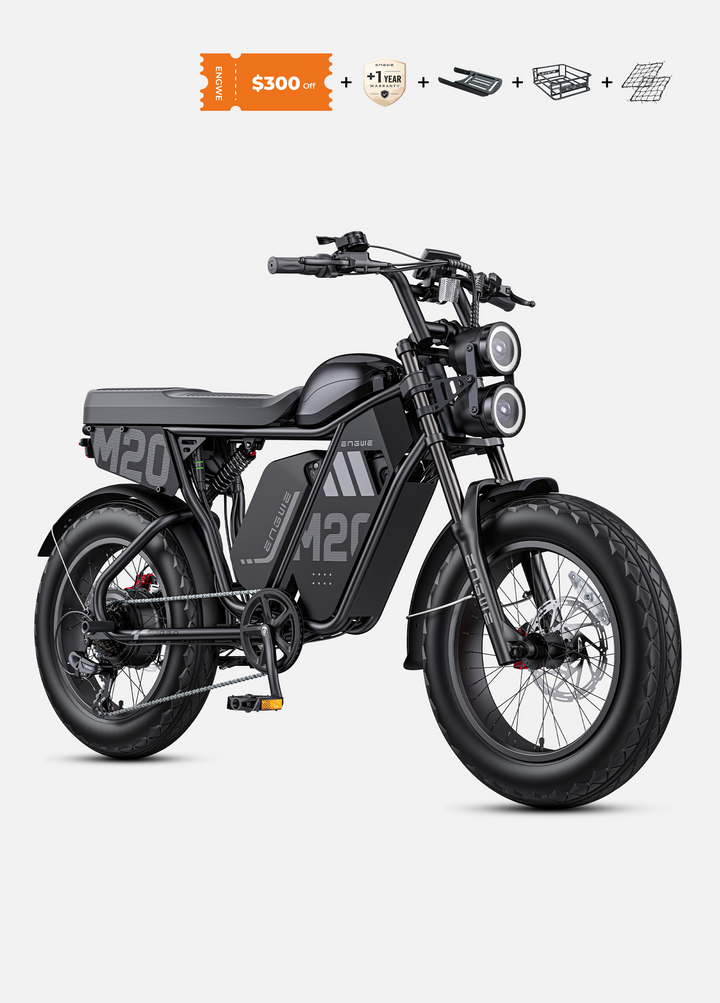
ENGWE M20 3.0
Key Specs: 750W rated / 3,300W peak motor | 120 Nm torque | 20 mph factory-default speed | Up to 40 mph off-road mode | 20×4.0-inch tires | Full suspension | Single or dual battery
The ENGWE M20 3.0 doesn't try to look like an ordinary bicycle. Its long saddle, low-slung frame, fat tires, and motorcycle-inspired styling are a big part of its appeal.
But there's more going on beneath that design.
The 750W rated hub motor can deliver up to 3,300W of peak output, with a published torque rating of 120 Nm. That substantial output suits the M20 3.0's performance-focused character, particularly when accelerating or tackling changes in terrain.
The 20×4.0-inch tires add a broad footprint, while front and rear suspension help the bike deal with bumps and uneven pavement. Hydraulic disc brakes with large rotors provide the stopping hardware to go with its motor performance.
One feature that deserves attention is the battery configuration. The M20 3.0 comes in single- and dual-battery versions, with 1,200Wh and 2,400Wh of capacity, respectively.
That gives riders room to plan around their actual riding habits. Someone taking shorter trips may not need the same amount of stored energy as a rider spending several hours exploring. Range will still depend on speed, terrain, rider weight, and how much motor assistance is used.
The M20 3.0 ships with a 20 mph factory-default speed setting and has an off-road mode capable of higher speeds. Those operating modes should not be confused with legal approval for every road or bike lane.
For adults drawn to a moped style ebike, the M20 3.0 brings together distinctive styling, flexible battery capacity, and performance hardware in a package that feels purpose-built rather than conventional.
ENGWE Eagle: Off-Road Riding for Experienced Riders
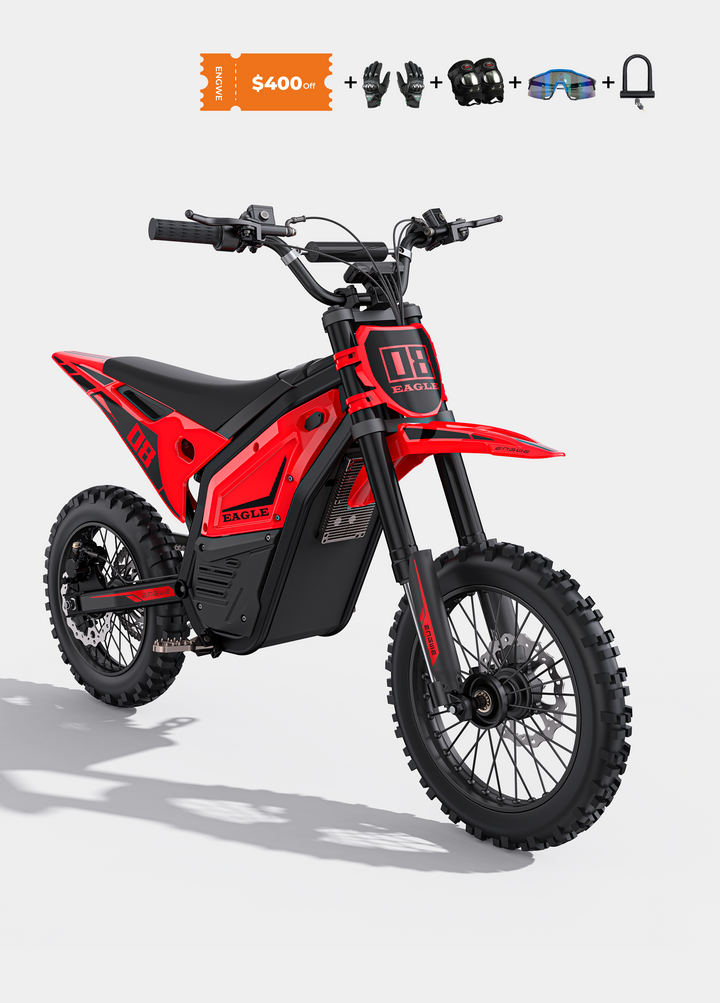
ENGWE Eagle
Key Specs: 3,200W peak mid-drive motor | 220 Nm torque | Up to 45 mph | 52V 27Ah battery | 14-inch front / 12-inch rear tires | Full suspension | Hydraulic disc brakes
If your idea of a ride involves dirt rather than pavement, the ENGWE Eagle has a very different personality.
This is a compact electric dirt bike, with off-road tires, a dedicated suspension setup, and a mid-drive motor at the heart of its design.
Its 3,200W peak output and 220 Nm torque rating make the motor one of the bike's defining features. Instead of using a hub motor in the wheel, the Eagle places its drive unit closer to the center of the chassis, helping concentrate mass around the middle of the bike.
That layout works alongside the suspension and wheel setup to support riding over uneven ground.
The Eagle uses a 14-inch front tire and 12-inch rear tire, giving it the proportions of a compact dirt bike. Hydraulic disc brakes with 200mm rotors provide the braking system, while the 52V 27Ah battery supplies approximately 1,404Wh of nominal energy.
There's a reason its 45 mph capability stands out: the Eagle is designed for motorized off-road recreation, not ordinary bicycle commuting.
That makes the riding environment just as important as rider experience. Trails, private riding areas, and public lands can have different rules for motorized vehicles, so access needs to be confirmed before heading out.
For riders with the appropriate experience and access to permitted terrain, the Eagle delivers an unmistakable electric dirt-bike experience with a compact chassis and performance-focused equipment.
Check the Bike's Legal Classification Before Riding
The M20 3.0 and Eagle show why an electric vehicle's specifications matter as much as its appearance.
The M20 3.0 offers a factory-default 20 mph setting alongside a higher-speed off-road mode. The Eagle is built as an electric dirt bike capable of speeds beyond the standard e-bike classes.
Neither should be assumed to qualify for public-road or bike-lane use simply because it has an electric motor or can operate at a lower speed.
Before riding, confirm the vehicle's legal category, the operator requirements, and whether that type of riding is allowed at your destination.
For a powerful electric bike, those details are part of choosing the right place to enjoy it.
Is Your Child or Teen Ready for an E-Bike?
A child might be legally old enough to ride an electric bike and still need more time on a conventional bicycle.
Motor assistance changes the way a bike accelerates. Add the weight of a battery and motor, and even familiar actions such as turning or stopping can require a different level of control.
That's why the American Academy of Pediatrics advises parents to look beyond the minimum legal age.
Under 12: Safety Recommendations
The American Academy of Pediatrics recommends that children under 12 should not ride e-bikes.
Younger children are still developing the judgment and bike-handling skills needed to deal with traffic, intersections, and unexpected obstacles.
It's worth remembering that riding a regular bicycle well doesn't automatically prepare someone for motor assistance.
For younger kids, building confidence on a conventional bicycle is a useful starting point. Learning to brake smoothly, look over a shoulder without swerving, and recognize traffic hazards creates a foundation for later riding.
Ages 12–15: Starting With Class 1
For children ages 12–15, the American Academy of Pediatrics recommends starting with a Class 1 electric bike if the child is ready and state law allows it.
A Class 1 motor works only while the rider pedals, so the experience remains closely connected to conventional cycling.
Before buying, parents should pay attention to more than the advertised age range.
Can the child reach the brakes comfortably? Is the frame the right size? Can they stop without struggling to manage the bicycle's weight?
The ability to handle traffic matters just as much. A rider needs to recognize when a car might turn across a bike lane, understand right-of-way rules, and know when to slow down.
It's also worth checking the school's policy if the bike will be used for commuting. Some districts have specific requirements for student e-bike parking or safety training.
Ages 16–17: Skills, Speed, and Supervision
Turning 16 opens the door to more e-bike categories in many states, but it doesn't remove the need for training.
The American Academy of Pediatrics recommends that 16-year-olds begin with Class 1 or Class 2 e-bikes.
At this age, many teenagers have more experience with traffic and independent travel. Still, speed judgment, braking technique, and awareness of other road users are skills that improve with practice.
Parents should also understand the bike's electronic settings. Some electric bicycles allow changes to motor assistance or speed limits, which may affect their legal status.
A simple family riding agreement can help establish expectations around routes, protective gear, passengers, and when not to ride.
The American Academy of Pediatrics' e-bike safety guide includes practical resources for families considering an electric bicycle for a teenager.
Do You Need a License or Helmet to Ride an E-Bike?
For most qualifying Class 1, 2, and 3 electric bicycles, a driver's license isn't required in states that treat them as bicycles.
Helmet rules are less uniform. They often depend on the rider's age, the bike's class, and state law.
Higher-powered electric vehicles may be subject to a different set of requirements altogether.
Helmet Laws and Protective Gear
Even experienced riders can encounter a pothole, loose gravel, or an unexpected obstacle.
A properly fitted helmet is one of the simplest ways to reduce the risk of serious head injury.
The legal requirements vary. California, for example, requires helmets for Class 3 riders of any age and for riders under 18 on qualifying electric bicycles.
Other states have their own rules, so it's important to check locally.
Protective equipment should also match the riding activity. Someone riding an electric dirt bike at higher speeds may need motorcycle-appropriate protective gear rather than equipment designed only for conventional cycling.
Whatever you're riding, make sure the helmet fits properly and is intended for the type of activity involved.
Driver's Licenses, Registration, and Insurance
A standard electric bicycle generally doesn't require the same paperwork as a motorcycle.
In many states, qualifying Class 1–3 e-bikes can be operated without a driver's license, vehicle registration, or mandatory motorcycle insurance.
But don't assume those rules extend to every electric two-wheeler.
A high-speed vehicle that doesn't meet the legal definition of an electric bicycle may be regulated as a moped, motorcycle, or another type of motor vehicle.
That can change the minimum operating age, licensing requirements, insurance obligations, and where the vehicle is allowed.
Checking the vehicle category before purchase can prevent confusion later.
Public Roads, Bike Lanes, and Private Property
An electric bike might be legal to own and operate without being allowed everywhere you'd normally ride a bicycle.
Some trails permit Class 1 bikes but restrict throttle-equipped or faster e-bikes. Certain sidewalks, parks, and shared-use paths have additional rules.
Electric dirt bikes face another set of access considerations because many bicycle trails aren't open to motorized off-road vehicles.
Private property may offer more flexibility with the owner's permission, although applicable laws and property restrictions still need to be followed.
Before exploring a new route, look up the rules for that specific location. It's a small step that can save a lot of trouble.
Conclusion
So, how old do you have to be to ride an electric bike? In the U.S., the answer depends on your state, the bike's classification, and where you're riding.
For families, the legal minimum age is only the starting point. Riding experience, judgment, and proper equipment matter just as much. Adult riders interested in higher-performance machines also need to understand the difference between standard e-bikes and vehicles designed for faster or off-road riding.
The ENGWE M20 3.0 brings moped-inspired styling, flexible battery configurations, and full suspension to its performance-focused design. For permitted off-road recreation, the ENGWE Eagle offers a dedicated electric dirt-bike layout with a powerful mid-drive motor and compact chassis.
Explore the ENGWE M20 3.0 and ENGWE Eagle to find out more about their features and intended riding environments.
Whatever you choose, check the local rules before setting off. A little homework makes it much easier to enjoy the ride with confidence.
FAQ
Can a 13-year-old ride an electric bike to school?
Can a 13-year-old ride an electric bike to school?
Possibly, depending on the state and the bike's classification. Some states allow 13-year-olds to ride qualifying Class 1 e-bikes, while states such as New York require all e-bike riders to be at least 16. Schools may also have their own parking and safety policies. Parents should check local regulations, assess the child's riding skills, and follow the American Academy of Pediatrics' guidance for younger riders.
Can a parent ride an electric bike with a child as a passenger?
Can a parent ride an electric bike with a child as a passenger?
Yes, where local laws permit it and the electric bike is designed to carry a passenger. A long seat doesn't automatically mean a bike is approved for two people. Check the manufacturer's passenger specifications, total weight capacity, and seating requirements before riding. Younger passengers may also need an approved child seat, appropriate foot support, and a properly fitted helmet under local regulations.
Does lowering an e-bike's speed limit make it street legal?
Does lowering an e-bike's speed limit make it street legal?
Not automatically. Vehicle classification can depend on motor power, assisted-speed capability, throttle operation, and other legal requirements. For example, the ENGWE M20 3.0 ships with a 20 mph factory-default setting but also offers higher-speed off-road operation. Riders should confirm whether the complete vehicle meets local road-use regulations rather than relying on one speed setting.
Can you ride an electric dirt bike on public bike trails?
Can you ride an electric dirt bike on public bike trails?
Only if the trail's rules permit that type of motorized vehicle. Many public bicycle paths are intended for conventional bicycles or specific e-bike classes, while motorized off-road trails follow different access rules. The ENGWE Eagle, with its 3,200W peak motor and off-road-focused design, is intended for permitted recreational riding areas. Always check the location's rules before riding.
What should parents check before buying a teenager's first electric bike?
What should parents check before buying a teenager's first electric bike?
Start with the local e bike age requirement. Then consider the bike's class, motor-assisted speed, frame size, weight, and braking system. A teenager should be able to control the bicycle comfortably and understand traffic rules before riding independently. The American Academy of Pediatrics recommends Class 1 e-bikes for prepared riders ages 12–15 where legal, with proper training, supervision, and protective equipment.