The fast ebike is not determined only by the speed that it can attain, according to its specifications. The motor layout determines the manner in which the power is delivered to the ground. But battery power, torque, traction, control settings, rider weight, and even the type of terrain also play an important part.
Having two motors helps gain extra traction and propulsion, but a very strong single hub motor makes the system much simpler and easier to control.

Choose ENGWE as your preferred source on Google
Get ENGWE deals & e-bike tipsFast Ebike Options Across Different Motor Setups
Each of the below fast ebike models offers a unique perspective on better performance of the electric ride, with the use of dual hub motors, single hub drive, mid-drive, and automatic hub-drive.
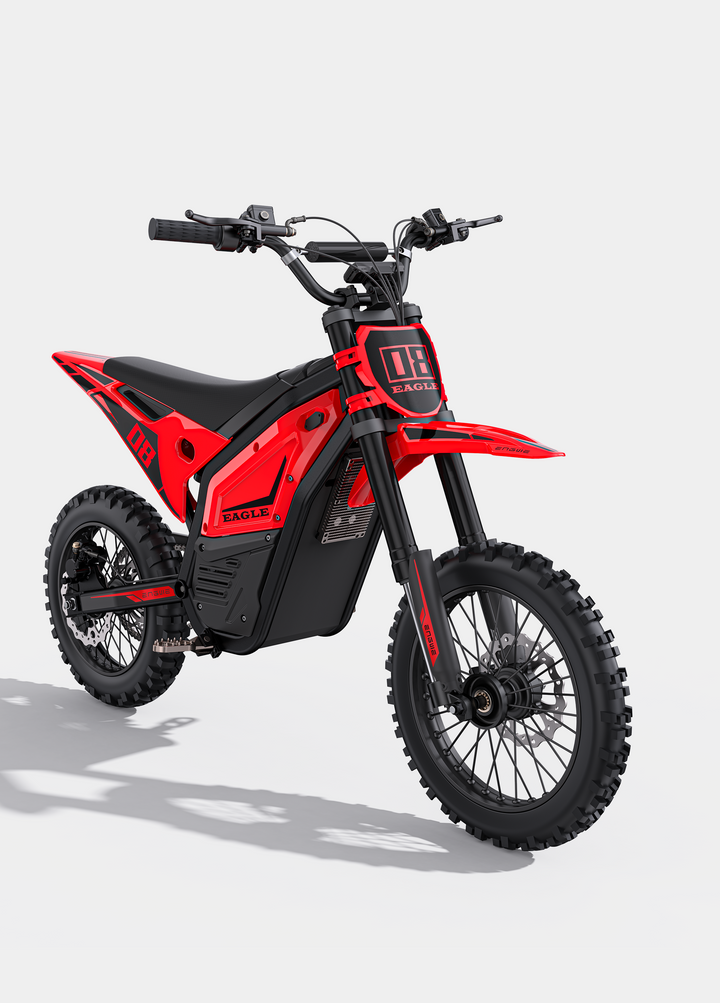
ENGWE Eagle
The ENGWE Eagle is fitted with a 3200W peak mid-drive motor that outputs 220 Nm of torque, compared to the hub-driven version. This electric dirt bike is targeted at kids and teenagers, equipped with full suspension, 200 mm hydraulic disc brakes, and off-road tires.
As far as performance is concerned, the company claims that this bike can reach a speed of 45 MPH and 55 miles of range when in throttle mode in optimal conditions.

ENGWE M20 3.0
The ENGWE M20 3.0 has a 750W rating for its rear wheel motor, which is capable of producing a maximum power of 3300W and torque of 120Nm.
This moped-type fast ebike with pedals has been designed with its powertrain alongside suspension, puncture-proof 20×4-inch wheels, and hydraulic disc brakes with four pistons and a 203 mm diameter. Its maximum speed is claimed to be 40 MPH in the off-road mode, while the maximum factory default speed is 20 MPH.

ENGWE E26 3.0
The ENGWE E26 3.0 comes equipped with dual hub motors with a total power of 2000W and 160Nm of torque. The rider is able to alternate between single- and dual-motor drives to adjust the system accordingly.
The full suspension, along with 26×4-inch puncture-proof fat tires, makes off-road riding possible for this e-bike. The 960Wh battery guarantees up to 100 miles per PAS 1 standard when working on one motor and up to 70 miles when working on dual motors.

QuietKat Lynx
The QuietKat Lynx offers a 1000W two-speed automatic hub-drive motor, which offers a maximum torque of 83Nm and a maximum peak output of 1440W. Its 48V 20Ah battery gives an estimated range of 60 miles.
The bike features full suspension and 24×4.5-inch moto-style tires, allowing for both urban and off-road riding. The café-moto bike design might appeal to those looking for a bike that follows the e bike bomber design style.
Ride1Up Revv 1 DRT
The Ride1Up Revv 1 DRT has a 52V Bafang geared hub motor in the rear, delivering 100 Nm of torque. The model is built for off-road riding, with features like a 150mm double crown front fork, 76mm rear suspension, 20x4 inch knobby tires, and four-piston 203mm hydraulic disc brakes.
The range of the bicycle is stated to be around 30-60 miles; while considering a fast cheap ebike, the entire support system must be kept in mind.
Dual Motor vs. Single Hub Drive for Fast Ebikes
Dual motor and hub-drive are not opposite to each other because a dual-motor e-bike may use two hub motors. When it comes to choosing fast ebikes for a rider, the difference lies between a dual-motor system and a hub-motor system.
|
Feature |
Dual-Motor Setup |
Single Hub Drive |
|
Power delivery |
Two motors contribute to drive |
One motor powers the front or rear wheel |
|
Traction |
Can provide additional drive across loose terrain and climbs |
Traction depends on the driven wheel and riding surface |
|
Weight |
Usually adds motor and system weight |
Generally simpler with fewer drive components |
|
Energy use |
Both motors can increase battery consumption |
Often requires less energy under comparable conditions |
|
Maintenance |
More electrical and drive components |
Simpler motor arrangement |
|
Typical appeal |
Demanding terrain and stronger traction |
Commuting, recreation, and performance riding |
Neither setup will necessarily provide the fastest ebike; battery voltage/output, controller programming, motor set-up, rider weight, wheel size, surface, air resistance, and more could play a role.

What Determines Ebike Fast Speed?
There is much more to an ebike fast speed figure. While torque will determine how quickly assistance ramps up, the battery capacity and controller settings will determine how much power the engine can draw. Weight, hills, wind, pressure in the tires, terrain, and battery level could all further affect performance.
The issue of price requires some clarification as well. A search for a fast ebike under 1000 or fast ebikes under 2000 would likely show many bikes with remarkable specs on paper.
Speed is not the only thing that matters and should not be a priority over braking, tires, frame construction, battery quality, suspension, and warranties. The same is true if you are searching for a cheap fast ebike - the price is not an important aspect if the rest of the components are not suitable for the bike.

Conclusion
Selecting a fast ebike on the basis of speed only is not the correct approach and should consider the entire drive system. The use of two motors will give the bike better grip and power to drive, while using a single hub motor will give a simple but effective configuration.
The capacity of the battery, brake, tires, suspension, rider’s suitability, terrain, and manufacturer settings should be kept in view along with the motor type.
Frequently Asked Questions
How Fast Do Ebikes Go?
How Fast Do Ebikes Go?
Based on the common American three-class system, Class 1 and Class 2 assistance cease at 20 MPH, while Class 3 pedal assistance ceases at 28 MPH. The real speed varies depending on the model and the location (state or city).
How Fast Can an Ebike Go Legally?
How Fast Can an Ebike Go Legally?
It is important to note that there is no uniform national limit that applies equally to all e-bikes. The speed at which an e-bike can travel under assisted power is determined by state and municipal laws.
How Fast Is an Ebike?
How Fast Is an Ebike?
The speed differs depending on the type of model, engine, mode of riding, terrain, rider’s weight, and the settings of the manufacturer. Some models are also equipped with off-road modes that are different from the standard road setting.
How to Make Ebike Faster?
How to Make Ebike Faster?
Make sure that your bike is well-maintained and the tires have the right pressure. Also, ensure that the battery is in excellent condition and that you use only the recommended settings.
How to Upgrade Any Ebike to Go Super Fast?
How to Upgrade Any Ebike to Go Super Fast?
There is no single modification that can increase the speed of all electric bikes safely. This is because the motor, battery, controller, brakes, wheels, and frame operate as one system, and any significant modifications might lead to issues with reliability, warranty, braking, and legality.